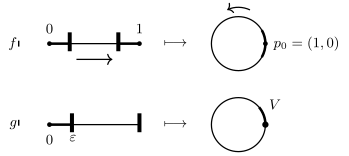
Goal: given a topological space and an equivalence relation on , the set of equivalence classes comes with a surjective map ,. (Think of it as “gluing together” the points of within each equivalence class.) We can then make the set into a topological space by equipping it with the following topology.
Definition 12.1. Given a surjective map (e.g. ), the quotient topology on has
(Exercise: check this is a topology on , in fact the finest topology for which is continuous.)
Relatedly: given topological spaces and , a continuous surjective map is a quotient map if the topology on is the quotient topology determined by and , i.e. if holds.
Example 12.2. with glued to : set , so is one equivalence class (all others are just ). The quotient map is
![Neighborhoods of 0 and 1 in [0,1] map to an arc around p_0; for g on [0,1), the image of 0,epsilon) is not open
(Check! Away from the end points, is a homeomorphism , so we only need to check at and . The point is: open in open in .)
Versus: is not a quotient map! is not open in , versus open in ; we want iff!
Example 12.3. Let and set ; we get the Möbius band.
A set containing is open , which contains and (and “matching” portions of the vertical edges), is open in .
Similarly, the torus:
and the Klein bottle:
And the wedge of two circles (“figure 8 space”):
If is a map such that , then we can define by , and then .
Set-theoretically, there is a bijection
Theorem 12.4. Equipping with the quotient topology, the above gives a bijection
i.e.: is continuous is continuous.
Proof. Let , be the quotient map, and recall (independent of the choice of ); so .
Assume is continuous. Then open, is open. By definition of the quotient topology ( open open), we conclude that is open. So is continuous.
Converse: since is continuous, if is continuous then is continuous. ∎
Example 12.5.; define an equivalence relation iff lie on the same line through the origin, i.e. for some ,. This is an equivalence relation. The quotient space is projective -space, with the quotient topology (“the space of lines through in ”).
A neighborhood of (the equivalence class of , i.e. the line through and ) corresponds to a “cone-like” open set in containing this line and all nearby lines through .
A continuous map is the same thing as a continuous map such that ,. (More about on HW4.)
Homotopy (Munkres §51)
Homotopy = a notion of continuous deformation, parametrized by .
Notes not reached in this lecture, covered at the start of Lecture 13
Definition 12.6. Let be two continuous maps. A homotopy between and is a continuous map (the factor is the “time” variable in the homotopy) such that
If this exists, then we say and are homotopic and write . If is homotopic to a constant map, we say it is nullhomotopic.
We’ll want to study paths in topological spaces, i.e. continuous, ,. The above notion is not useful for paths if we don’t fix the end points and (see HW5). A better notion: homotopy of paths only considers homotopies which keep the end points in place.
Here are homotopic paths, and is not homotopic to and .
Definition 12.7. Two paths from to are (path) homotopic if a continuous such that
and
so that , is a path from to . Such is a path homotopy, and we write .
Lemma 12.8. and are equivalence relations.
Proof.
Clearly (constant homotopy ).
If with homotopy , then the reverse homotopy gives .
Assume with homotopy and with homotopy . Then the concatenation of these is defined by
These two formulas agree at (), so is well-defined and continuous (cf. the “pasting lemma”, Thm 18.3), and gives a homotopy .
In the case of path homotopies, we can check that the above constructions preserve the requirements and , so they yield path homotopies.
∎
Example 12.9. (1) If are paths in (or any convex subset of ) from to , we can define the straight-line homotopy
For each , this connects to by a straight line segment. We conclude: always!
(2) In the punctured plane , let be paths from to such that stays in the upper half plane and stays in the lower half plane .
Then there is no path homotopy between and in (we’ll prove this rigorously later).
Homotopy equivalence
Definition 12.10. Spaces are homotopy equivalent if , such that and (homotopic, vs. exact inverses, which would make them homeomorphic).
(Check: this is an equivalence relation.)
Many of the simplest examples arise from deformation retractions:
Definition 12.11.
Given , a retraction is a map such that , or equivalently, denoting by the inclusion, .
Say is a deformation retraction if additionally is homotopic to by a homotopy that fixes .
It then follows that is a homotopy equivalence.
Example 12.12. (or a convex subset of ) deformation retracts onto :,. Check: the zero map is homotopic to by . (We say is contractible.)
Example 12.13. is not contractible, but it deformation retracts to by , (in this case, by the straight-line homotopy).
By the same argument, the cylinder and the Möbius band deformation retract onto the “middle” by sliding points of to the midpoint. (Check: this is consistent with the twisted gluing of ,.)
Hence they are homotopy equivalent to (and to each other, and to ).
Example 12.14. deformation retracts onto the wedge of two ’s, (“figure 8” space), or also onto the “theta graph” (homotopy equivalent to the figure 8, not homeomorphic!).
Products of paths and the fundamental groupoid
We now focus on paths and path homotopy as a way to define an algebraic invariant of topological spaces (up to homotopy equivalence): the fundamental group. A group needs a multiplication?
Definition 12.15. If is a path from to and is a path from to , define a path from to by running through first , then (twice as fast):
This product is well-defined on path-homotopy classes, as long as : if and then , using the homotopy
Picture:
So we define .
Proposition 12.16 (Claim). This operation is associative, and has identity and inverses.
Remark. the “fundamental groupoid” of : the category with objects = points of and .
category: composition is associative, and there exist identity morphisms ;
groupoid: all morphisms have inverses.
Proof.Identity. Given , consider the constant path ,, and let . We claim that if is any path from to , then .
Indeed, there are explicit homotopies , and similarly :
Inverse. Given a path from to , define the reverse path from to . Then is inverse to , namely and . Indeed:
For given , this runs forward along from to at , then backwards to at . For we get ; for ,. (Similarly for .)
Associativity. Given paths with and , we claim . Both run along , then , then , but with different parametrizations. The homotopy comes from adjusting for this: